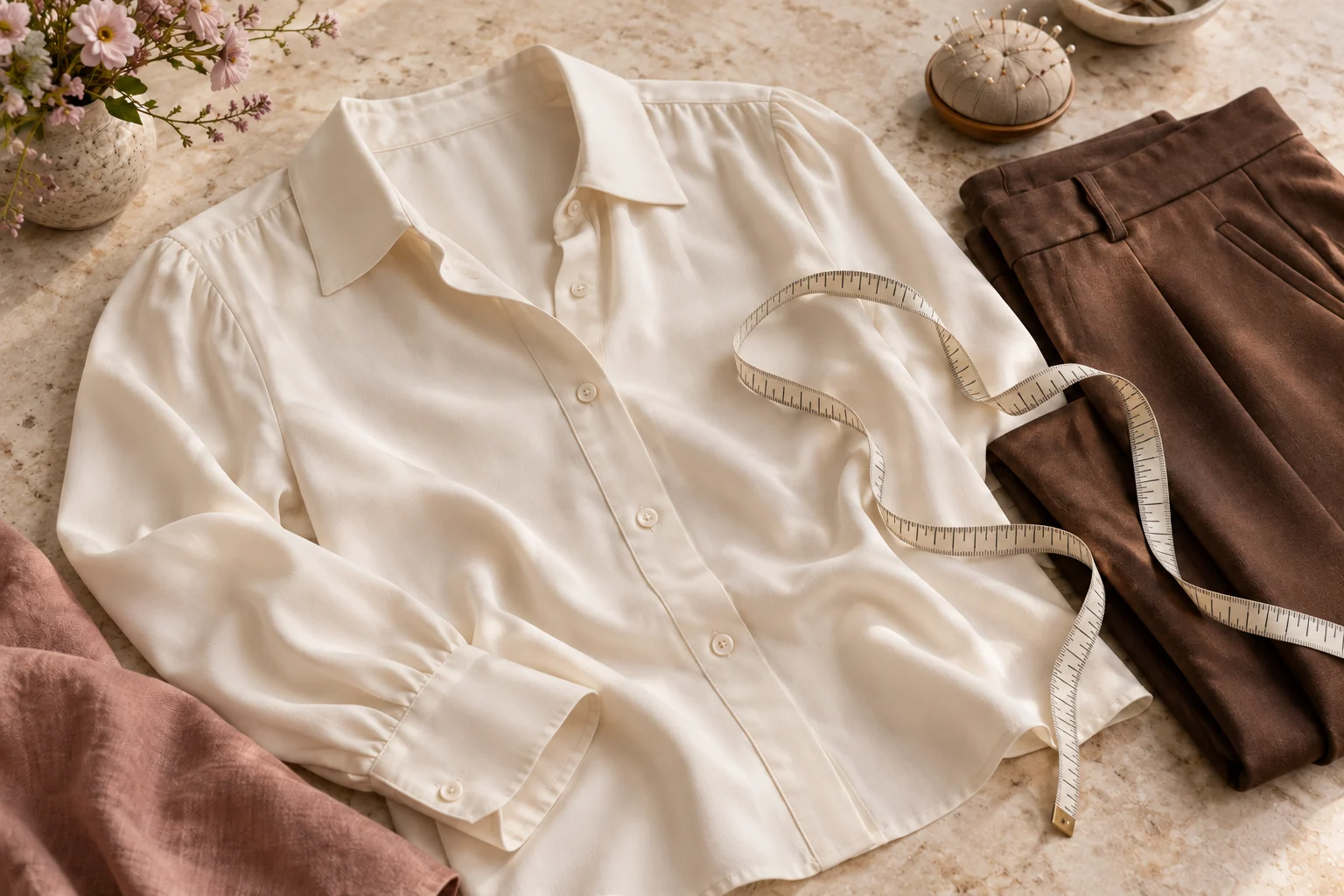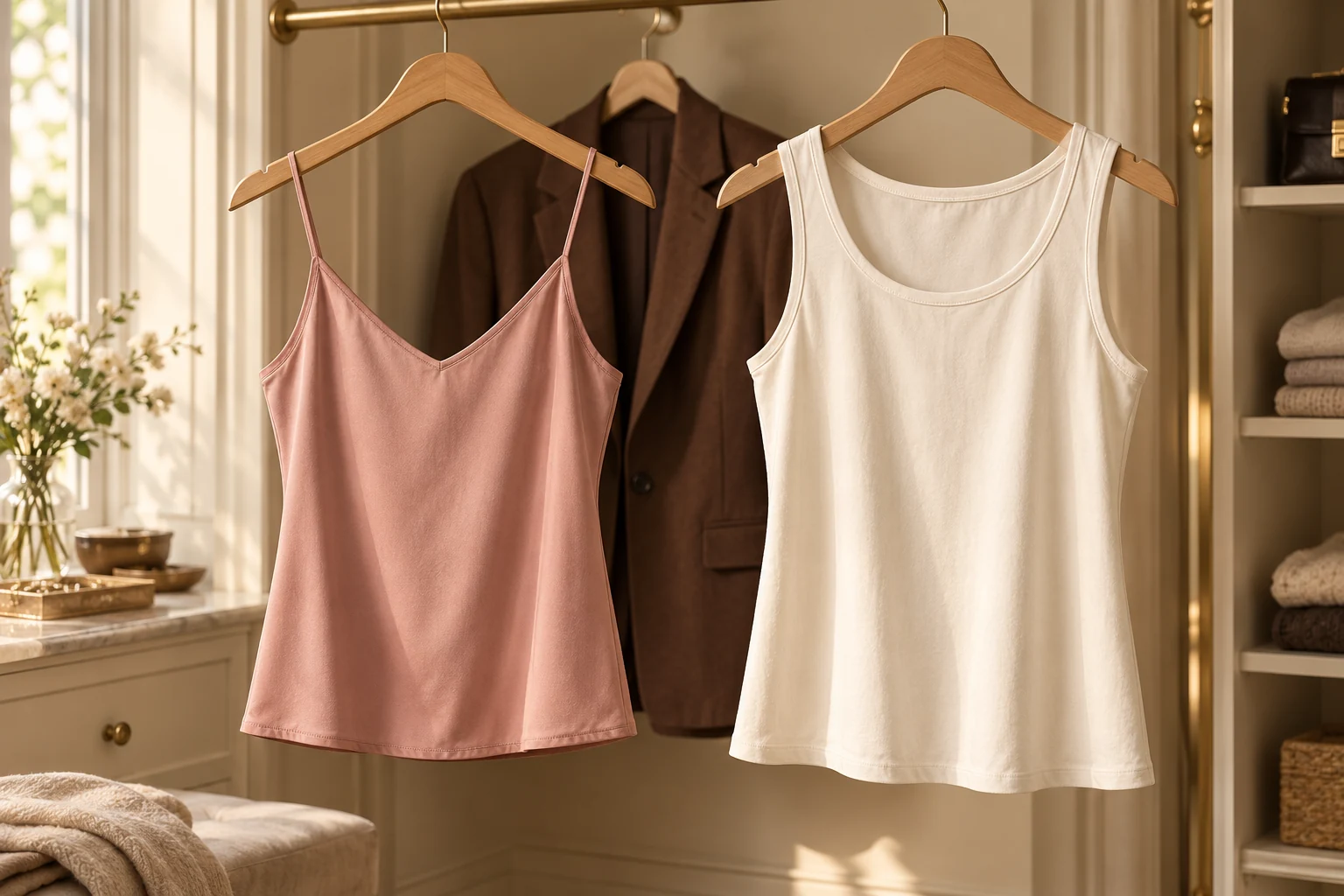
A camisole usually has narrow shoulder straps; a tank top usually has wider straps. Either can work as a layer. Choose by the neckline, armhole, length and surface detail you need under your actual shirt or jacket, not by the category name alone.
If you want a lower, more open line inside jacket lapels, start with a camisole. If you want more fabric across the upper chest or shoulders, look at a higher-neck tank. Those are starting points: a low-cut tank can reveal more than a high-neck cami, and neither name promises opacity, support or a particular fit.
Start with the Outer Layer
Put on the shirt, cardigan or jacket you want to complete. Decide whether the base layer should be seen or stay mostly hidden. This simple distinction makes browsing much easier.
Under an open blazer, the base layer becomes part of the outfit's neckline. Under a buttoned shirt, you may want its upper edge to sit below the opening. Under a sheer blouse, even a low neckline can remain visible through the fabric, so think about the whole shape rather than only the front opening.
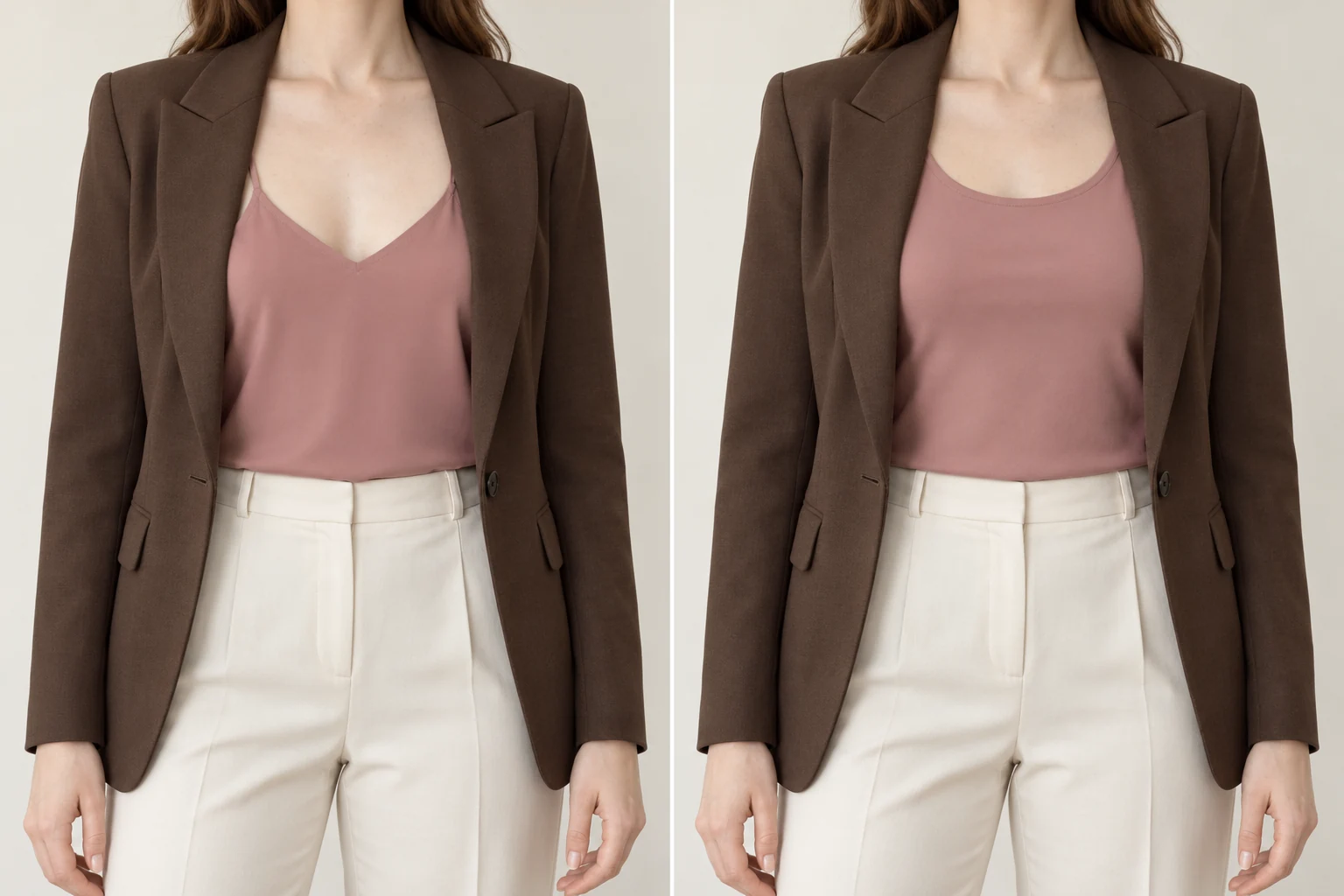
The V and curved necklines above create different lines inside the same lapels. Neither is inherently more polished. Choose the amount of coverage and the shape you prefer with your jacket, then check it while sitting and moving, not only while standing still.
Look beyond Strap Width
The Neckline and Armhole Work Together
A higher front neckline will not solve a low armhole at the side. Look at side and back photographs, especially if you want a top that you can wear without its jacket. If you plan to wear a bra underneath, compare its neckline, back and straps with the top; broad tank straps do not automatically conceal every bra strap.
Adjustable camisole straps can change where the neckline sits, but only when that feature is actually present. They do not replace choosing the right size. A top that pulls or gaps elsewhere needs a different fit, not simply shorter straps.
A Pretty Detail May Be the Point
Lace trim, pleats, buttons or a textured surface can look good when the layer is visible. Beneath a close-fitting shirt, those same details may show as outlines. Decide which job the top needs to do before choosing the detail.
For example, the collection's Pleated Button-Down Spaghetti Strap Cami has its pleating and buttons in the name; do not treat it as a featureless undershirt. The Square Neck Wide Strap Tank is a different neckline and strap option to inspect. Check each listing's photographs and measurements rather than assuming either has built-in support.
Journelle's camisole guide similarly distinguishes narrow cami straps from wider tank straps and recommends considering surface detail when layering. The useful next step is to assess the entire outline under the garment you own.
Check the Hem with Your Pants or Skirt
The length that works with high-rise pants may not work with a lower waistband. For a tucked layer, you need enough fabric to remain in place during normal movement without creating a bundle at the waist. For an untucked layer, check where its hem ends in relation to the outer shirt and waistband.

In the seated combination above, the camisole overlaps the jeans and the shirt extends farther at the sides. That is one way to keep the inner hem visible without matching the two lengths. Try your own combination seated, reaching forward and with the outer shirt buttoned if that is how you intend to wear it.
If you keep pulling the underlayer down, do not assume that a tighter size will fix it. Check its length, the fit around your torso and how it interacts with the waistband. Product measurements are more useful than a general “longline” or “cropped” label.
Do Not Read More into the Fabric Name Than It Says
A camisole is not necessarily silk, and a tank is not necessarily cotton. A smooth finish does not identify the fiber. A garment can also have a lining or built-in bra, but those features need to be stated rather than inferred from a front photograph.
Opacity depends on the specific garment and lighting, not simply whether the top is called a cami or tank. If coverage matters, inspect it over the undergarment you intend to wear in ordinary daylight and indoor light when you can try it on. Before ordering, ask about any missing lining or opacity information rather than relying on a studio image to prove it.
Make the Choice for One Real Outfit
For a visible base under a blazer, compare neckline shapes first. For a quiet layer under a fitted shirt, start with a plain surface and check how the layers sit together. For a top you will also wear on its own, give the side and back coverage as much attention as the front.
You do not need both categories for every outfit. Choose the top that does the job with the shirt, jacket and bottom you already plan to wear. If you are splitting a coordinated outfit, the same approach helps you give a matching set's bottom a new top without rebuilding your wardrobe.