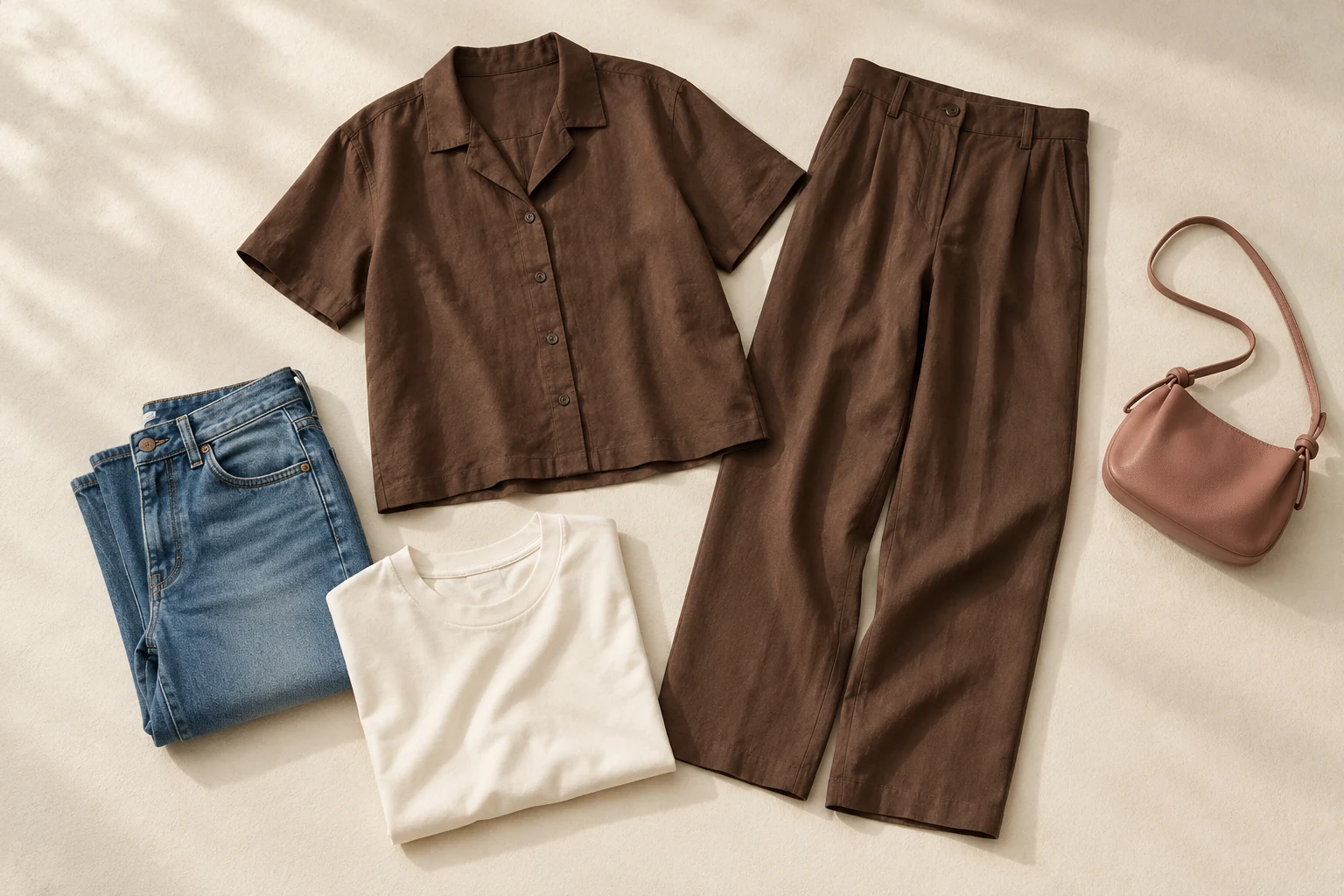
Yes, you can wear a matching set as separates. Start by pairing just one piece with something you already wear often: the set's shirt with jeans, or its pants with a plain top. Before buying a set for versatility, check that you like both pieces independently and that each fits without relying on its partner to hide an awkward hem or waistband.
A coordinated outfit is useful in its own right. It does not have to produce a certain number of extra looks to be worthwhile. But if wearing the pieces apart is your reason for buying, a little outfit planning is more useful than a promise of “endless combinations.”
Put the Set through a Two-Outfit Test
Look at the top on its own and name one bottom you already own that you would wear with it. Then do the reverse for the set's bottom. Be specific: your dark straight-leg jeans and your ivory crewneck, rather than “some jeans” or “a nice top” you would still need to buy.
Check the meeting point between the garments. A cropped top may meet the set's high waistband but leave a gap with your usual jeans. A long shirt may cover an elastic waistband you do not want visible with a shorter top. Neither feature is wrong; it simply changes which separate outfits you will actually use.
If you have the set at home, lay out both combinations before adding shoes or a bag. If you are shopping online, compare the listed lengths and the front, side and back photographs. A missing view is a reason to ask for detail, not to assume the cut.
Change One Piece, Then Look Again
Keep shoes and accessories the same for the first try-on. That way, you can see what changing the clothes does rather than rebuilding everything at once.
Keep the Top, Change the Bottom
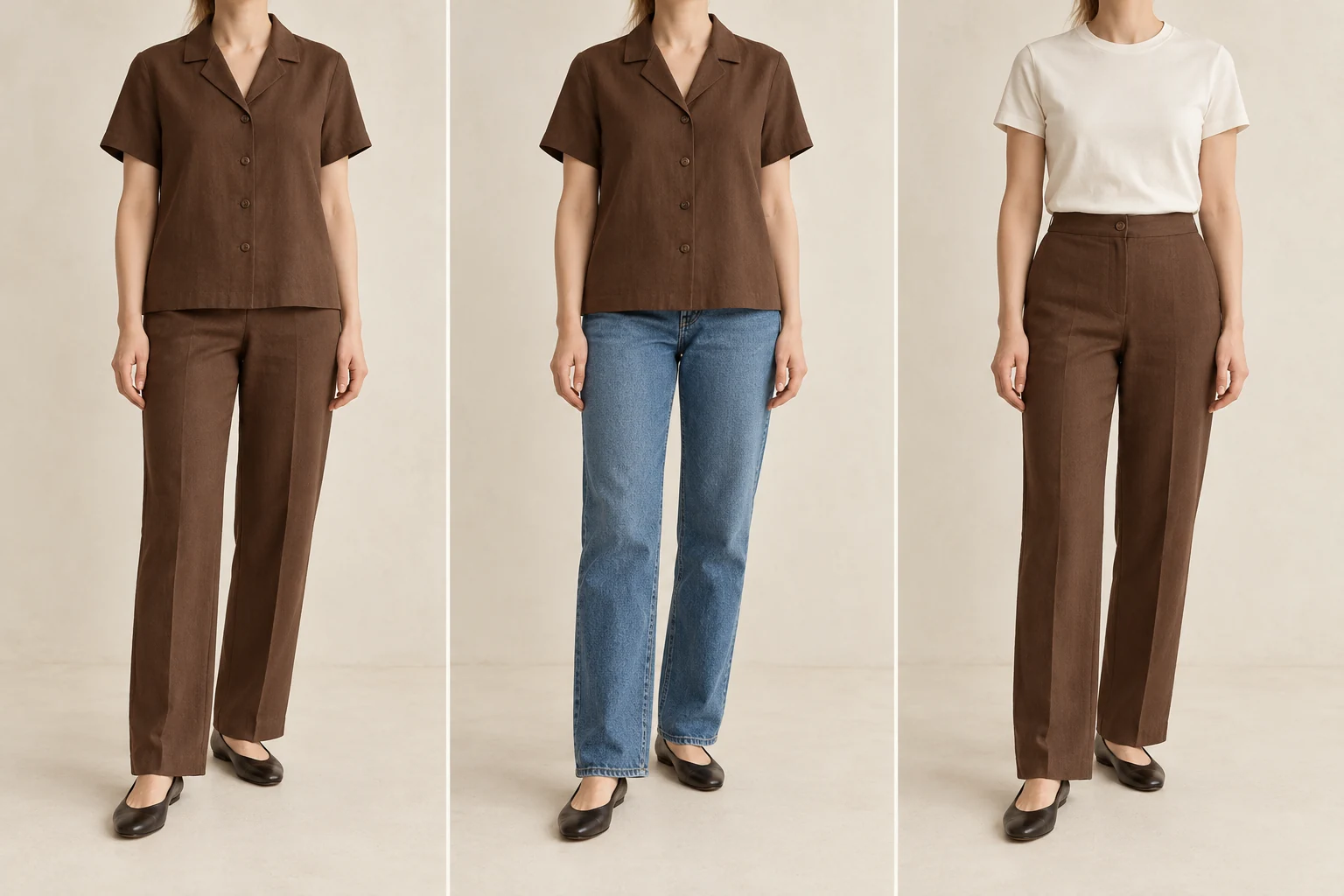
A plain set shirt with jeans is a straightforward starting point. Leave it untucked if you like the visible hem, or try a tuck if there is enough length and the waistband can accommodate the fabric without bunching. There is no requirement to tuck a set top just because you are wearing it separately.
For a printed top, choose one color in the print and try a bottom in that color. Denim is another option. You do not need to avoid bold prints: the question is whether you already own a partner you enjoy wearing with that particular pattern.
Keep the Bottom, Change the Top
Try the pants or skirt with a simple T-shirt, tank or shirt. A close-fitting top leaves the lower garment's outline easy to see; a looser top creates a different, more continuous shape. Compare both rather than treating one as the correct choice for your body.
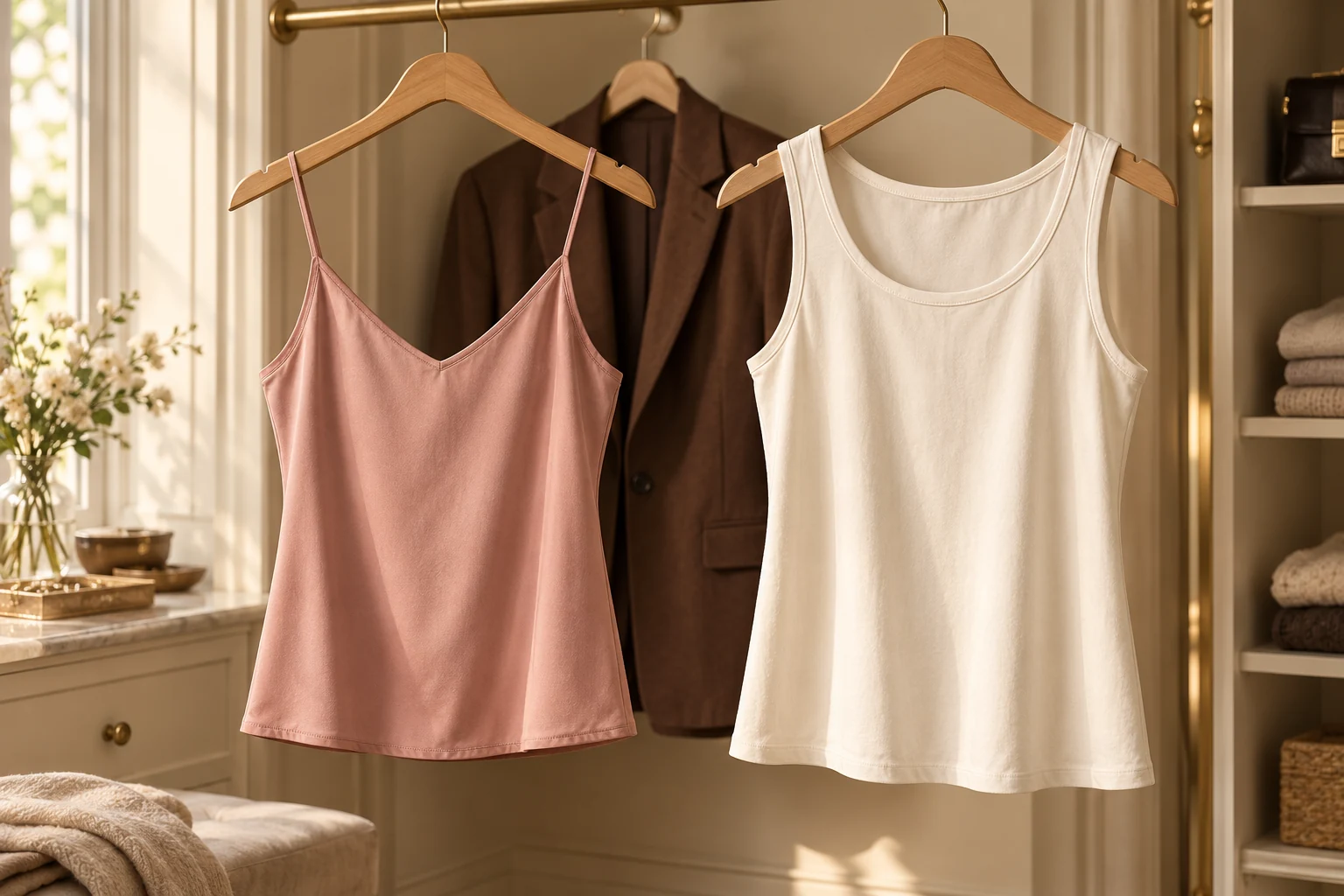
Notice where the new top ends. If it lands exactly on a pocket opening, drawstring or gathered waistband, try a slightly shorter or longer top before changing the whole outfit. For an open jacket over the new combination, our camisole and tank layering guide explains how to choose the visible neckline.
Decide What You Want to Keep from the Matching Look
You can preserve a color connection without matching every surface. Brown pants with an ivory top and brown shoes repeat a shade in a smaller area. A printed skirt with a plain shirt picks up the print less literally. Alternatively, keep a similar shade and let different textures show; an almost-match is not automatically a mistake.
If the outfit feels more relaxed than you intended, compare it with one structured item, such as a jacket or a firm-shaped bag. That is an option, not a guarantee of office or event suitability. A dress code still depends on the particular venue, garment coverage and occasion.
Trendsend's styling examples also show set tops with different pants and set bottoms with simple tops. Our useful test is narrower: can you make a combination with clothes already in your wardrobe, without adding another purchase?
Check the Set as Two Garments before Ordering
- Read what is included. A photographed jacket, belt or underlayer is not necessarily part of the set. Use the product description, not the styled image alone.
- Check both pieces' measurements. If a set uses one size selection for both pieces, that does not mean both will suit you equally. Do not assume you can order different top and bottom sizes unless the listing offers that choice. Our body and garment measurement guide explains which numbers you are comparing.
- Look for independent closures and coverage. Decide whether the top works closed or needs an underlayer, and whether you want the waistband visible when worn with another top.
- Read each care label. Matching appearance does not prove identical fiber content or care. Follow the instructions for each piece; do not assume they can share a wash load. If one says hand wash, read what a delicate cycle does and does not replace.
The One-Button Blazer and Wide-Leg Pants Set and Button-Down Shirt & Shorts Set in this collection offer different starting points to inspect: a jacket-and-pants combination versus a shirt-and-shorts combination. Evaluate the actual pieces and their measurements rather than treating every matching set as interchangeable.
It Is Fine to Buy a Set for One Outfit
If you love the full look but would never choose either piece separately, judge it as one outfit. That is a clearer purchase decision than counting hypothetical combinations you do not want to wear. For a versatile buy, choose the set that passes your two-outfit test, then add other combinations only when they are useful.